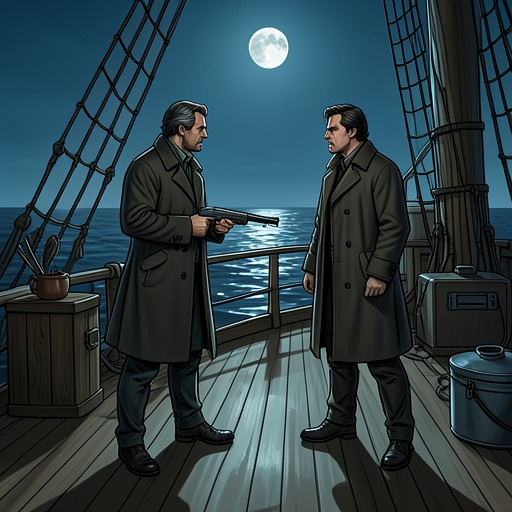
Baxter plotted the murder of Sumner and Drax
The North WaterJacob Baxter’s timber-yard plot is an attempt to silence Patrick Sumner, eliminate Henry Drax, and disguise both deaths as a mutual killing. Its precision is also its weakness: Baxter plans the weapons, the staging, the route, and the explanation investigators are supposed to accept, while Sumner later recognizes the design and confronts Baxter with it.
Causes and Stakes
The plan takes shape after Sumner leaves Baxter’s house. Baxter remains at his desk for nearly half an hour, then goes up to the attic, where Drax is staying. Baxter tells him that Sumner knows too much, or can piece together enough to cause trouble, and that it was difficult to stop him going to a magistrate. The immediate danger, as Baxter sees it, is not simply that Sumner suspects wrongdoing: a formal inquiry could threaten the money on which both men’s prospects depend.
Baxter distinguishes between what Sumner knows and what he suspects. Drax insists that Sumner cannot know about the sinking. Baxter agrees that Sumner may not know, but says he recognizes that something was wrong, pointing to the Volunteer’s northward course when other ships were sailing south. The contrast makes the scheme’s exposure depend on inference rather than a witnessed confession. Sumner’s suspicions are enough, in Baxter’s judgment, to make him dangerous.
The financial background reaches beyond this attic conversation. Baxter has previously pressed Arthur Brownlee to consider the profit represented by twelve thousand pounds divided three ways, describing it as far greater than the likely return from whaling. Later, Campbell warns that the whales are only a small part of the undertaking and that the ship must be sunk in a way that looks convincing to underwriters. Drax, too, regards the appearance of the sinking as important. These earlier dealings establish the commercial stakes that Baxter invokes when he tells Drax that Sumner’s disclosures could end their income and bring severe legal consequences. Sumner later accuses Baxter of arranging the Volunteer’s sinking, but Baxter denies that accusation; the details of the timber-yard plan itself are presented as Baxter’s instructions, not as proof that every part of the earlier suspected conspiracy has been established.
Recruitment and the Proposed Encounter
Baxter has arranged a room for Sumner at the Pilgrim’s Arms and proposes sending a woman there to occupy him. Yet he does not want the killing to happen at the inn, where too many people are about. He tells Drax that Sumner must be lured elsewhere and offers to have Stevens deliver a message. Drax chooses the old timber yard on Trippett Street, beyond the foundry, as the place to wait.
Baxter then summons Stevens from the hallway into his study. Stevens has the revolver Baxter gave him and its bullets; Baxter asks to inspect the weapon and returns it. He assigns Stevens a specific errand for midnight: go to Sumner’s room, claim that Baxter urgently needs to speak to him about important news concerning the Volunteer, and lead him toward the river. Because Sumner does not know the town or Baxter’s house, Stevens can direct him along Trippett Street and into the timber yard, describing the route as a shortcut if Sumner questions it. Drax will be waiting there.
Stevens offers to shoot Sumner himself, but Baxter rejects the suggestion. The order matters to the design: Drax must fire the first shot, and Stevens must then shoot Drax. Baxter’s arrangement turns each man into the apparent killer of the other, while making Stevens an agent who is supposed to disappear before he can be connected to the deaths. The staged sequence is the essential mechanism of the plot, not an incidental detail.
Staging the Double Murder
Baxter instructs Stevens to put a revolver in Sumner’s hand, empty the pockets of both Sumner and Drax, and leave the yard. He anticipates that a constable at the dock may hear the shots and come running. In Baxter’s imagined account, the constable will find two dead men, each holding the weapon that killed the other, with no witnesses or other indications to point toward a third participant. The authorities, he expects, will be left with two unidentified men and a scene that seems to explain itself.
Even the arrangement of the bodies and weapons is treated as a matter of forensic appearance. When Stevens repeats the sequence back, Baxter specifies that Drax must be shot in the chest, not the back, and that the gun must be placed in Drax’s right hand rather than his left. These instructions show how carefully Baxter tries to make the physical evidence support his intended interpretation. He does not merely want the men dead; he wants the scene to suggest reciprocal violence and to conceal the person who organized it.
Baxter’s confidence rests on the absence of witnesses and on the anticipated simplicity of the authorities’ conclusion. He imagines that the constable will summon help, that the bodies will be taken to the morgue, and that no one will claim them. In this account, the supposed neatness of the crime is itself a form of protection: if investigators accept the appearance of two men killing one another, Baxter believes there will be no reason to look for the person who arranged their meeting and their deaths.
The Alliance Under Strain
The plan is also Baxter’s attempt to end his dependence on Drax. In explaining it to Stevens, he says that killing Drax will free him from Drax’s threats and financial demands. Yet Baxter still needs Drax’s experience and composure to carry out the first killing. He refuses to substitute Stevens for Drax, even though Stevens is armed, because the order of events is integral to the intended staging. Baxter’s effort to rid himself of Drax therefore begins by making Drax indispensable to the plan.
Their arrangement is further strained by Drax’s condition and reluctance. When Baxter wakes him in the attic, Drax has been drinking and initially resists taking on the task, suggesting that Stevens do it instead. Baxter insists that Stevens cannot be trusted with this particular job and appeals to the fortune at stake. Drax agrees to the proposed location, but the conversation shows that Baxter’s control is not absolute: he must persuade the man he hopes to eliminate to perform the first, most consequential act. The plot depends on cooperation between partners whose interests have already diverged.
Exposure and Failure
The narrative later gives Sumner a chance to name the plan. He tells Baxter that Baxter had Cavendish sink the Volunteer and that Drax and Sumner were the only men who might have known or guessed it. Sumner describes the intended sequence—Drax shooting him, followed by Stevens shooting Drax—and concludes that it did not happen as planned. This is Sumner’s accusation during their confrontation; Baxter does not concede its truth, instead replying that two men are dead in the timber yard and that Sumner killed one of them, making Sumner dependent on his assistance.
That reply shifts the immediate issue from the intended staging to the consequences of its failure. Sumner’s ability to recount the sequence means that the plan has not kept its design hidden from him, while Baxter tries to redirect attention toward Sumner’s involvement in the deaths. The scheme’s central irony is that its elaborate effort to make violence look self-explanatory does not prevent a surviving participant from interpreting it. The timber yard is meant to close the matter; in Sumner’s account, it instead becomes the place from which the hidden arrangement can be reconstructed.